
Harlan’s History: Wrecked off Stone Harbor: One Life Lost, Ten Saved, December 30, 1912
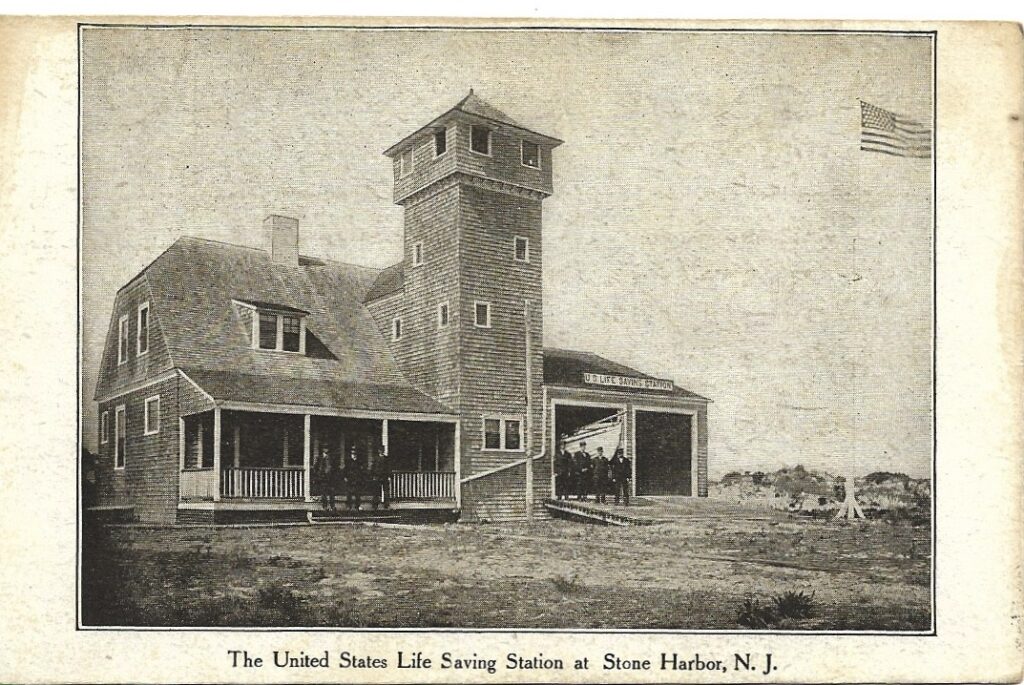
Accompanying this written account are 2 very old postcard images showing the United States Life Saving Station located at Stone Harbor, N. J. There will also be included two typewritten pages that are currently housed in the Stone Harbor Museum archives that represent a newspaper reporter’s submission to the Cape May County Gazette on Friday, January 3, 1913. Hopefully, you will find that reading about this little-known story about a 1912 shipwreck and dramatic rescue that took place at Stone Harbor, N. J. to be both interesting and even exciting!
On the cold morning of December 30, 1912, a seagoing tug called the “Margaret” was on her way southward to Norfolk, Virginia. The steamship, built in 1904, was being pummeled by 45-mph gale force winds and rough seas while towing three very heavy barges from the port of New York City. Believed to have struck an old submerged shipwreck a few miles off Avalon, the “Margaret” started taking on water and found it necessary to cast off the three barges and head for the nearest shore. The tug struggled but eventually made it to a point some 300 yards off the Seven Mile Beach, whereupon she was observed by members of the Avalon lifesaving service. Avalon immediately put out a telephone distress call to the keeper at Tathams Life Saving Station at Stone Harbor for additional assistance. So this is where this heroic narrative begins.
A herculean effort was made by the life-saving crews of both stations and one of the lifesavers was known to have exclaimed that the conditions and difficulty of launching a boat into the breakers that day was continuously thwarted by what was described as a “cauldron of raging seas.” In fact, it was no easy task to initiate the rescue and launch the gasoline-powered surfboat. It took all of the power of two propellers along with the brute strength of seven oarsmen to finally get their rescue boat beyond the breakers and heading toward the foundering tug.’
Meanwhile, hampered by what would become hurricane-force winds and worsening weather conditions, the tug took a real pounding. It was only through sheer perseverance and dedication that the experienced rescuers in their surfboat eventually prevailed. After considerable time and struggle, the lifesavers were able to get a line thrown to the crew on board the disabled tug and successfully bring 10 crew members to their safety with two harrowing rescue trips. Unfortunately, there was one fatality, a James Duncan who was the fireman serving aboard the tug “Margaret.” In due course, the U.S. Lifesaving Service would honor twelve men from both the Tathams and Avalon Stations with distinctive gold medals (8 of them from Stone Harbor and 4 from Avalon) for their individual bravery. The Secretary of the U.S. Treasury praised these brave men, saying, “superb surfmanship had won the day.”
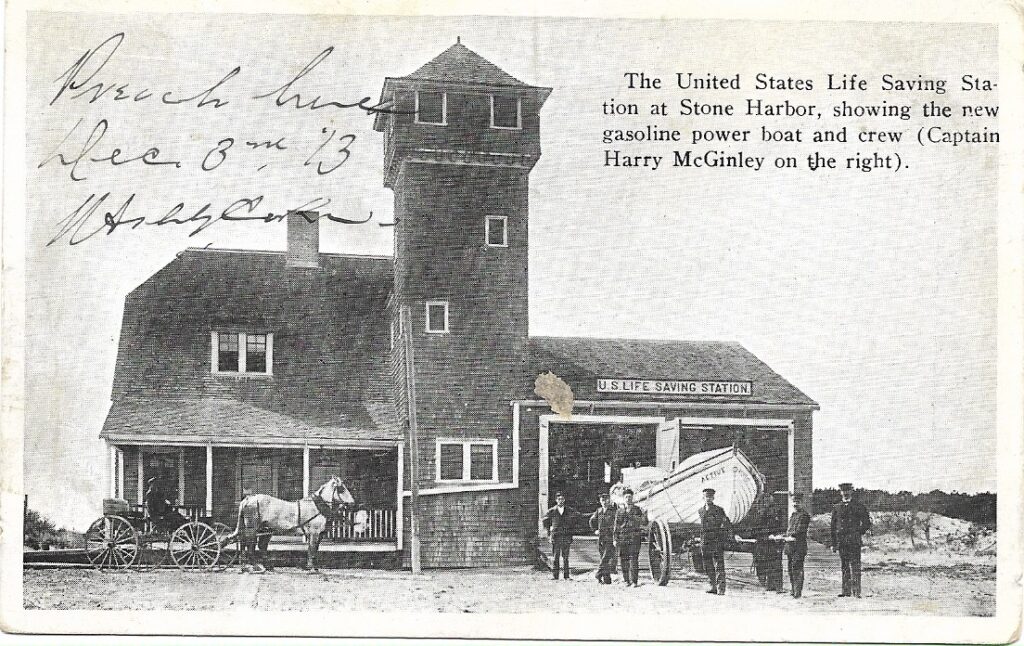 This second image depicted here is another vintage picture postcard showing an earlier view of the U.S. Life Saving Station at Stone Harbor and, judging from the hand-written inscription on the front upper-left, indicates the following date: “Dec. 3rd, 1913.” Interestingly, this particular postcard was actually written and mailed less than one year after the day of the aforementioned shipwreck.
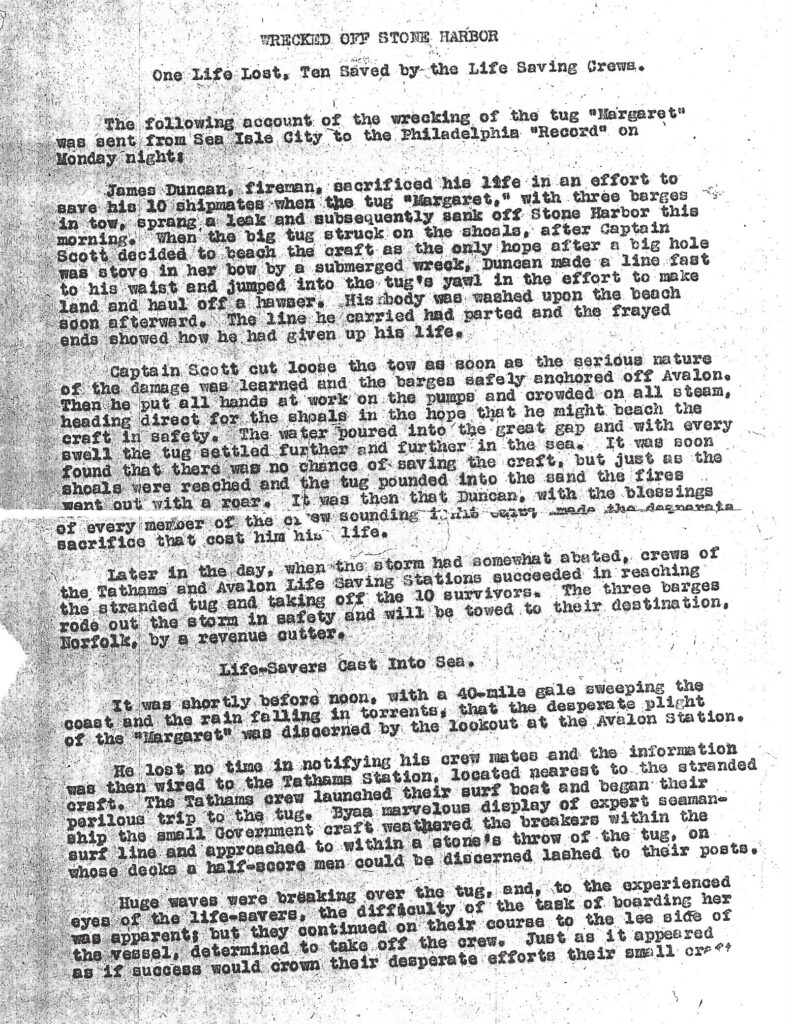
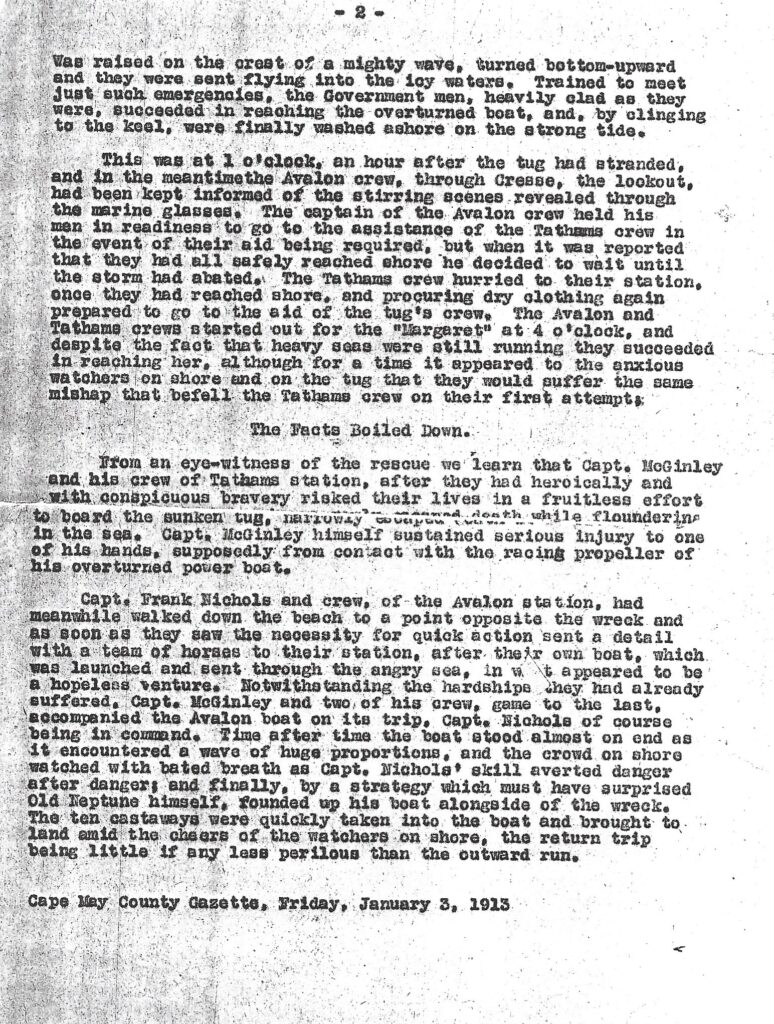
The newspaper account as it was submitted:
The following two-page account of the wrecking of the tug “Margaret” was sent from Sea Isle City to the Philadelphia “Record” for publication in the Monday night edition of January 6, 1913. I do hope you enjoy reading this unknown columnist’s report in its entirety. Such news, particularly up and down the Jersey Coast, about shipwrecks always captured the attention of the large newspaper reading audience, and it was hard to ignore those glaring headlines in large, bold print announcing yet another calamitous maritime event.
It should be remembered that during the latter 1800s and early 1900s, the specially trained life saving crews were considered among the greatest of heroes who routinely risked their lives to save others at sea, often under very dangerous conditions. Astoundingly, there are 4,594 known and documented shipwrecks that have occurred just along the shoreline of New Jersey. This particular area of the New Jersey coastline is commonly known to be one of the most dangerous along the entire Atlantic seaboard. It should be noted that during this time there was still considerable ship traffic bound for ports like Boston, New York, Philadelphia, Baltimore and others. Many of the ships of that era were tall-masted sailing ships, some with wood hulls and increasingly many more with metal hulls. The notorious foul weather months, the countless shifting offshore sandbars, unceasing strong currents and especially dense fog, not to mention the periodic severe storms and hurricanes along the New Jersey coast, would be responsible for the stranding of many a vessel over the years. Therefore, it is a well-known fact that the New Jersey coast is littered with the remnants and broken skeletons of countless wrecked vessels.
Incidentally, the names of two of the more famous South Jersey shipwrecks include: the “Sindia” shipwreck at nearby Ocean City in 1901 and the “Fortuna” at Ship Bottom, Long Beach Island in 1910. Both these two maritime events have been well documented and can be easily “Googled,” resulting in plenty of detailed information for more interesting reading.